
Contributing authors: Kris Acheson-Clair, Jennifer Ma, Shagufa Kapadia, Curtis Chu
Theme: Conceptualizations/Frameworks of VbE
Tasks: Point to foundational publications; Recommend an approach or strategy
Keywords: values-based education, character education, transformative learning, moral development, Equilintegration Theory
Positionality Statement: We write as members of the GAVE Research Committee — a diverse group of scholars working across educational contexts, disciplines, and national settings, united by a commitment to Values-Based Education as both a research agenda and a practice. This post reflects our collective interest in making VbE scholarship more accessible to a wider global audience: not by simplifying the ideas, but by offering the kind of theoretical orientation that allows practitioners and researchers at any entry point to locate their work within a broader intellectual conversation.
Introduction
Values-Based Education (VbE) is a broad ‘church’. Its practitioners include elementary/primary teachers cultivating respect, responsibility, and empathy through daily classroom rituals, university faculty guiding students through disorienting encounters with difference, leadership educators designing curricula to build ethical judgment and civic responsibility, non-government organisations that implement community-based interventions to cultivate social responsibility, leadership, and gender sensitivity, and educators in many other roles. What these practitioners seem to share is a commitment to educating the whole person — not just filling minds with content, but shaping the values, dispositions, and character that determine how learners engage with the world.
What VbE practitioners do not always share is a common theoretical language.
This is the first post in what we hope will be an ongoing GAVE blog series on the conceptual foundations of VbE. It aims to offer a broad orientation to the theoretical landscape — not to settle debates, but to map the terrain so that contributors and readers can locate their own work within it. We will sketch two major traditions that have shaped how educators think about values, note where they converge and diverge, and suggest why that distinction matters practically for anyone designing a VbE intervention.
The Definitional Problem — and Why It Matters
One respected scholar in this field has aptly described the definitional landscape of Values-Based Education as a ‘semantic morass’ (Berkowitz, 2011, p. 13). A quick online search of the word ‘values’ bears this out: the term appears in corporate mission statements, religious doctrine, and political rhetoric, with little shared meaning underneath. In educational contexts, the word ‘values’ is variously used to mean attitudes, dispositions, character traits, moral principles, competencies, and beliefs. For example, in the Australian curriculum, key values include “doing your best” as a Personal and Social Capability. Rarely do definitions from different global or disciplinary contexts line up neatly.
This is not merely a vocabulary problem. It is an epistemological one. If we do not have a precise model of what a value is, how it forms, and how it differs from a belief or an attitude, we cannot design interventions that reliably cultivate values — and we cannot explain why some approaches succeed while others fail or even backfire. An upcoming post in this series will address the backfire phenomenon in depth.
The definitional challenge is compounded by the fact that VbE draws on at least two distinct scholarly traditions — one rooted primarily in child development and K-12 schooling, the other in adult learning and higher education — and these traditions carry different assumptions about how values work and how they change.
Two Traditions in Values-Based Education
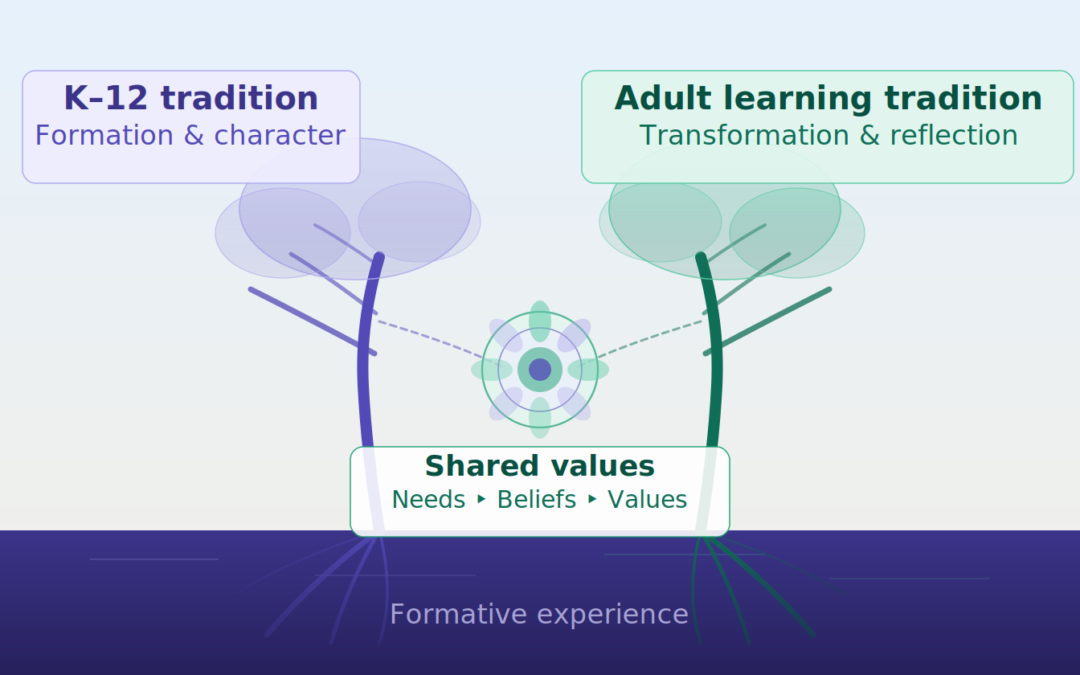
The K-12 Tradition: Formation and Character
The older and, in some respects, more extensively institutionalized tradition in VbE has developed primarily in the context of children’s schooling. Rooted in moral philosophy, developmental psychology, and civic education, this tradition asks: what kind of person do we want young people to become, and how does education shape that formation?
Theorists in this tradition include Lawrence Kohlberg, whose stage theory of moral development proposed that children move through increasingly sophisticated forms of moral reasoning; Thomas Lickona, whose character education framework emphasized the integration of moral knowing, moral feeling, and moral action; and Marvin Berkowitz, whose extensive empirical work on what works in values education identified specific pedagogical conditions that reliably support character development (Berkowitz, 2011; Lickona, 1991).
What these approaches share is an emphasis on formation — the idea that values are being built during childhood and adolescence, and that educators play a central role in shaping that process through modeling, environment, explicit instruction, and structured experience. The school is understood as a moral community, and the teacher as a moral agent whose own values and conduct are inherently pedagogical.
This tradition has generated a rich body of evidence-based practice, particularly in K-12 settings. Its influence is also visible in teacher education, where preparing educators to be deliberate about their own values and their moral responsibilities to students is increasingly central to professional formation.
Research Spotlight
Did you know that Australia developed and implemented a National Framework for Values Education in over 400 public, private, and religious schools from 2003 to 2010? This large-scale, government-funded initiative embedded values education across diverse school communities and generated one of the most extensive national datasets on VbE implementation to date — offering researchers and practitioners a rare opportunity to examine what values-based approaches look like when applied at system scale, across varied cultural and institutional contexts.
The Adult Learning Tradition: Transformation and Critical Reflection
A second major tradition has developed in the context of adult and higher education, and it begins from a different premise: that by adulthood, people already have established values, beliefs, and meaning-making frameworks via a combination of formal education and familial and community socialization — and that continued learning works not by forming values from scratch, but by transforming already-held frames of reference.
The central figure here is Jack Mezirow, whose Transformative Learning Theory describes learning as a process of revising the assumptions, beliefs, and value commitments through which we interpret our experience (Mezirow, 1997, 2000). For Mezirow, the catalytic event in transformative learning is the ‘disorienting dilemma’ — an experience that cannot be accommodated within one’s existing framework and that prompts critical reflection on the assumptions one has previously taken for granted. The goal of adult education, on this account, is not to transmit values but to cultivate the capacity for autonomous, reflective self-determination.
This tradition has been foundational for higher education practitioners working in intercultural learning, study abroad, diversity education, and leadership development — contexts where the primary task is helping adult learners examine and revise the values, cultural assumptions, and identity commitments they bring with them into the educational encounter.
The adult learning tradition tends to treat values as more conscious and cognitively accessible than the character education tradition does. Mezirow’s original formulation was criticized by later scholars for overemphasizing rational reflection at the expense of the emotional, relational, and somatic dimensions of transformation (Christie et al., 2015; Dirkx, 2012). Subsequent developments in the field have worked to integrate more affective or emotional perspectives, but the tension between rational-discursive and depth-psychological accounts of transformation remains a point of productive theoretical discussion.
Research Spotlight
Did you know that genuine transformation may have less to do with cognition than with emotion and imagination? John Dirkx, drawing on Jungian psychology, has described genuine transformation as “soul work” — an imaginative, affective engagement with the images, feelings, and meanings that animate our inner lives.
Where the Traditions Meet — and Where They Fall Short
These two traditions are not simply sequential (children first, then adults). They represent genuinely different theoretical assumptions about human motivation and value change, and practitioners in each can learn from the other.
Both traditions agree that values are not primarily transmitted by telling people what to value. The empirical record of failed values interventions — from Drug Abuse Resistance Education (D.A.R.E) and ‘Just Say No’ campaigns to mandatory sentencing policies — bears this out (Shealy & Bhuyan, 2009). Effective VbE, whether with children or adults, involves something more: structured experience, authentic relationship, reflective practice, and pedagogical conditions that allow learners to engage their own beliefs rather than passively receive others’.
Where the traditions diverge most sharply is on the question of how conscious and cognitive values are. The character education tradition, following Aristotle, understands virtues as habits — dispositions shaped through practice, modeling, and environment, often below the level of explicit awareness. The transformative learning tradition, following Habermas, emphasizes rational discourse and critical reflection as the primary mechanisms of change.
Neither account is complete. A growing body of cross-cultural empirical research suggests that values are deeply affective and in large part non-conscious — grounded not primarily in reasoning but in needs, formative experiences, and emotional commitments developed over a lifetime. This insight challenges both the transmission assumptions of some character education approaches and the rationalist assumptions of some transformative learning frameworks.
An Integrative Lens: The Needs-Beliefs-Values Framework
One theoretical contribution that bridges the K-12 and adult learning traditions is Craig Shealy’s Equilintegration (EI) Theory and its applied counterpart, the EI Model (Shealy, 2016). Developed through decades of cross-cultural empirical research, EI Theory proposes a developmental sequence:
Needs → Beliefs → Values.
From birth, our formative experiences — family environment, cultural context, significant relationships, early encounters with safety and belonging — shape how well our core human needs are met. Over time, we develop beliefs that serve those needs as best they can. Values are not something separate from beliefs; they are beliefs that carry strong positive or negative emotions. They represent what we care about most, derived from and in service of underlying needs.
This framework has important implications for both VbE traditions. For character educators, it helps explain why modeling and environment matter so much in childhood: formative experiences are literally constructing the needs-belief structures from which adult values will emerge. For adult learning practitioners, it helps explain why transformation is so difficult and why it can provoke such strong resistance: values are not propositions to be argued away but expressions of identity, grounded in what people have needed to be true in order to navigate their lives.
EI Theory also introduces a distinction between the teaching of values and the teaching about values — that is, between designing curricula to cultivate specific values in learners and deliberately helping learners understand what values are, where they come from, and how they function. This metacognitive dimension has been shown empirically to support deeper and more sustained growth outcomes across educational contexts (Acheson et al., 2023; Acheson & Dirkx, 2021; Wandschneider et al., 2015). It is a distinction with practical implications for program design at every level, from primary school to professional development.
A Cross-Cultural Note: Values Are Not Universal, but the Framework Is
Any theoretical framework for VbE must grapple with cultural variation. Schwartz’s Theory of Basic Human Values, validated across more than 80 countries, identifies ten motivationally distinct values — ranging from self-direction and stimulation to tradition, conformity, and security — and maps the dynamic tensions and compatibilities among them (Schwartz, 1992, 2006). A consistent finding across cultures is that values exist in a structured system of conflict and congruence: pursuing one value frequently comes at the cost of another, and educational interventions that do not account for this dynamic can produce unintended consequences.
This cross-cultural framework is a useful reminder that while specific values vary across cultural and educational contexts, the structural dynamics of how values form, conflict, and change appear to be broadly shared features of human psychology. VbE practitioners working across national and cultural contexts can draw on this research base to ground their work in something more than local assumptions of what is right or good.
Conclusion: Why Theory Matters for Practice
VbE is one of the most ambitious educational orientations of our time, and it is gaining momentum across a widening range of contexts — from K-12 character development and teacher education to higher education, leadership formation, sustainability education, and international learning. As this GAVE blog series unfolds, contributors will explore specific frameworks, research findings, and practical approaches from across that spectrum.
Our argument in this opening post is simple: practitioners in both the K-12 and the adult learning traditions have important things to offer one another, and both are enriched by theoretical frameworks that take seriously the non-conscious, affective, and developmental dimensions of how values actually form and change. A critical understanding of how different theoretical orientations influence our perspectives and approaches to VbE can help us to be clearer about not only what we want to implement and see happen, but also how we can best test and verify this to account for why something worked or not. Robust theory is what allows us to design interventions that genuinely transform rather than merely comply with good intentions — and to learn from the cases in which values-based programs fall short.
Subsequent posts in this series will explore what empirical research has revealed about measuring values change, and what happens when values-based programs get the design wrong.
References
Acheson, K., … Wiley, J. (2023). Demonstrating the value of values-based education: What we’ve learned about learning from the Beliefs, Events and Values Inventory (BEVI). In T. Lovat & R. Toomey (Eds.), International research handbook on values education and student wellbeing (2nd ed., pp. 1–29). Springer.
Acheson, K., & Dirkx, J. (2021). Introduction: Special issue assessing transformative learning. Journal of Transformative Education, 19(4), 295–305. https://doi.org/10.1177/15413446211045158
Berkowitz, M. W. (2011). What works in values education. International Journal of Educational Research, 50(3), 153–158. https://doi.org/10.1016/j.ijer.2011.07.003
Christie, M., Carey, M., Robertson, A., & Grainger, P. (2015). Putting transformative learning theory into practice. Australian Journal of Adult Learning, 55(1), 10–30. https://files.eric.ed.gov/fulltext/EJ1059138.pdf
Dirkx, J. M. (2012). Nurturing soul work: A Jungian approach to transformative learning. In E. W. Taylor & P. Cranton (Eds.), The handbook of transformative learning: Theory, research, and practice (pp. 116–130). Jossey-Bass.
Lickona, T. (1992). Educating for character: How our schools can teach respect and responsibility. Bantam.
McClain, A. L. (2024). New developments in transformative learning. New Directions for Adult and Continuing Education, 184, 20-29. https://doi.org/10.1002/ace.20540
Mezirow, J. (1997). Transformative learning: Theory to practice. New Directions for Adult and Continuing Education, 74, 5–12.
Mezirow, J. (2000). Learning as transformation: Critical perspectives on a theory in progress. Jossey-Bass.
Schwartz, S. H. (1992). Universals in the content and structure of values: Theoretical advances and empirical tests in 20 countries. Advances in Experimental Social Psychology, 25, 1–65. https://citeseerx.ist.psu.edu/document?repid%20=rep1&type=pdf&doi=dc49e27d0ed890cd3ed2e80ca0b0107207f12a64
Schwartz, S. H. (2006). Les valeurs de base de la personne: théorie, mesures et applications. Revue française de sociologie, 47(4), 929–968. https://www.jstor.org/stable/pdf/20453420.pdf?casa_token=j_52gFSXT3gAAAAA:eo1xV6tMASYcBQ4EgQuMYjlAKQEKR8-LJkPQV6IvwA6DTRotDPsRDG3mfOsbNysmd8mwgGfmivhShJ9mwrjLGwtSO8d9lNZZlp-zkvAIkLk-oH6taEs
Shealy, C. N. (2016). Beliefs, Events, and Values Inventory (BEVI). In C. N. Shealy (Ed.), Making sense of beliefs and values: Theory, research, and practice (pp. 115–173). Springer.
Shealy, C. N., & Bhuyan, D. (2009). The value of value based education. In M. Mukhopadhyay (Ed.), Quality school education for all (pp. 94–113). Education Technology and Management Academy.
Wandschneider, E., Pysarchik, D. T., Sternberger, L. G., Ma, W., Acheson, K., et al. (2015). The Forum BEVI project. Frontiers: The Interdisciplinary Journal of Study Abroad, 25, 150–228. http://frontiersjournal.org/wp-content/uploads/2015/09/WANDSCHNEIDERetal-FrontiersXXV-TheForumBEVIProject.pdf