
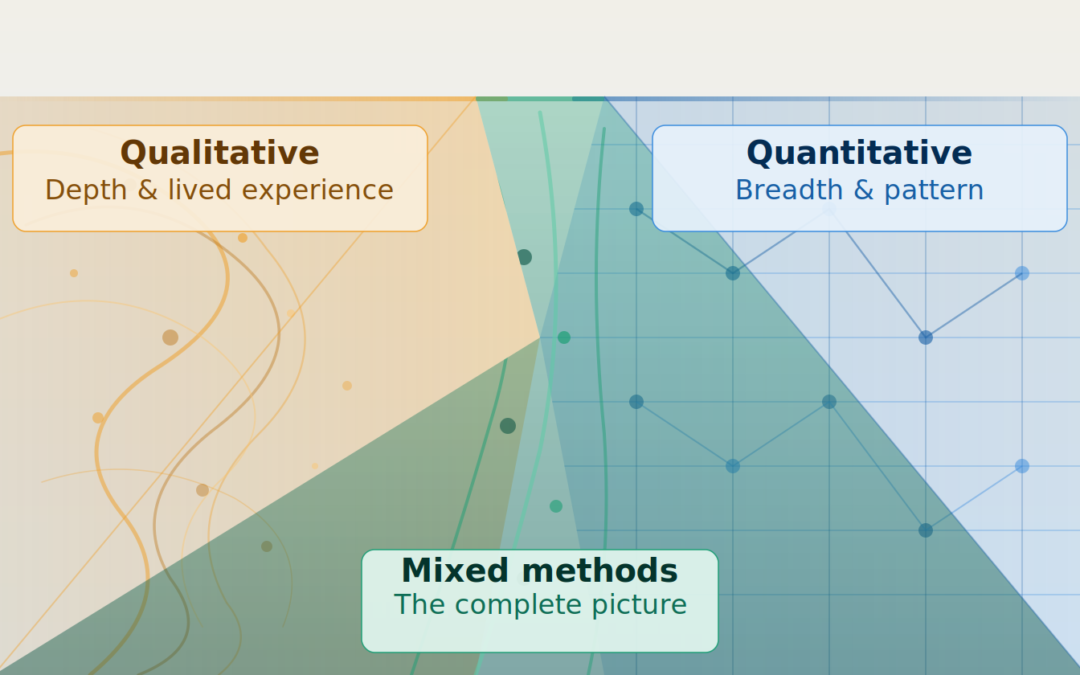
Contributing authors: Kris Acheson-Clair, Jennifer Ma, Shagufa Kapadia, Curtis Chu
Theme: Research Methods in VbE
Tasks: Point to foundational publications; Recommend an approach or strategy; Identify a direction for inquiry
Keywords: research methods, qualitative inquiry, quantitative assessment, mixed methods, values change, BEVI
Positionality: We write as members of the GAVE Research Committee — a diverse group of scholars working across educational contexts, disciplines, and national settings, united by a commitment to Values-Based Education as both a research agenda and a practice. This post reflects our collective interest in making VbE scholarship more accessible to a wider global audience: not by simplifying the ideas, but by offering the kind of methodological orientation that allows practitioners and researchers at any entry point to locate their work within a broader intellectual conversation.
Introduction
Research in Values-Based Education is not one thing. It operates at three distinct levels, each requiring different methods and asking fundamentally different questions. The first post in this series addressed the level of theory: what are beliefs and values, where do they come from, and how do they change? The third post will address the level of practice: what does effective VbE look like in real educational settings? This post occupies the terrain between them — the level of outcomes research, where the central question is: how do we know if values are actually changing as a result of educational interventions?
This distinction matters more than it might initially appear. A great deal of what is published under the banner of VbE research is better described as practice documentation — rich, valuable accounts of what programs do and how they are experienced. That work is essential. But it is not the same as evidence that values changed. Documenting a program’s design, philosophy, or participant satisfaction tells us what was intended and how it felt; it does not, on its own, tell us whether the intervention produced genuine development in learners’ values, or for whom, or why.
Generating that kind of evidence requires deliberate methodological choices. This post surveys the main options available to VbE researchers — qualitative, quantitative, and mixed methods — with an eye to both their distinctive strengths and their limitations for the specific challenge of documenting values change.
Qualitative Approaches: Getting Inside the Experience of Change
Qualitative research involves collecting and analysing non-numerical data, such as text, video, and audio data obtained from, for example, interviews, focus groups, observations, case studies, documents, and records. Qualitative methods have been the dominant tradition in VbE research, and for good reason. Values are deeply personal, context-dependent, and often non-conscious — precisely the kinds of phenomena that qualitative inquiry is designed to illuminate. These methods do not ask whether change occurred at a statistically measurable level across a population; they ask what change looked and felt like for particular people in particular settings, and what meanings learners made of their experiences. Due to the more subjective nature of qualitative approaches, it is important for researchers to acknowledge and account for their own personal experiences and biases in the research process, particularly when interpreting findings.
Narrative Inquiry and Phenomenology
Narrative inquiry is among the most widely used qualitative approaches in VbE research, treating the stories people tell about their experiences as primary data, on the premise that human beings make sense of their lives and their values through narrative (Connelly & Clandinin, 1990). For VbE outcomes research, narrative approaches are well suited to tracing the arc of values change over time — how a learner’s story about themselves shifted, what triggered that shift, and how they integrate new values commitments into a coherent sense of identity. Phenomenology asks a related but distinct question: not what happened in a particular learner’s story, but what it is like, at the structural level, to undergo values transformation — to have moral assumptions challenged, to experience genuine empathy across difference, or to pass through the kind of disorienting dilemma that Mezirow, the American sociologist and founder of Transformative Learning (TL) theory, identified as catalytic for transformative learning. Both approaches reveal the texture of values in ways that pure survey data cannot, and both share the same core limitation: they work with small numbers of participants in depth, and their findings are inherently contextual. These, and other qualitative methods, assume that there are multiple realities of lived experience. That is to say that what may be deemed as ‘true’ and ‘real’ to one person may not generalise to another person’s experience of the same situation, event, or phenomena. These methods cannot tell us how widespread the experience is, or what conditions reliably produce it across a population.
Case Study and Participatory Action Research
Case study research examines a bounded instance — a school, a program, a classroom, a cohort — in depth, integrating multiple data sources to build a rich, contextually grounded account. In VbE research, well-designed case studies can document how particular program designs interact with particular institutional and cultural environments to produce (or fail to produce) values development — asking why programs work or fail in ways that controlled studies cannot capture. Participatory Action Research (PAR) takes this further by involving participants as active co-investigators rather than research subjects, enacting in the research process itself the respect for learner agency that VbE advocates pedagogically. The trade-off for both approaches is that they cannot establish whether values change is reliable, generalizable, or causally attributable to the intervention at scale. That kind of evidence requires quantitative methods.
Research spotlight: Did you know that case study methods have been used to investigate the impact of VbE in a UK primary school context? In this qualitative project, the doctoral researcher (at the time) was also the Head Teacher/Principal of the main school site under investigation.
Quantitative Approaches: Measuring What Changes and for Whom
Quantitative methods bring a different set of capabilities to VbE outcomes research. Their strength is not depth of understanding but breadth of evidence: the ability to document whether change occurred across a population, to what degree, in what direction, and for which subgroups. Used well, quantitative approaches can detect patterns — including patterns of differential impact — that qualitative methods, working with small samples, are unlikely to reveal.
The Challenge of Measuring Values
Values present a distinctive measurement challenge. Unlike knowledge or skills, which can be directly demonstrated, values are internal, affective, largely non-conscious, and resistant to surface-level self-report. Asking learners whether they feel more open, more empathic, or more committed to fairness after an educational experience is methodologically treacherous: their answers are shaped at least as much by who they were going in as by what the program did. For example, research using the Beliefs, Events, and Values Inventory (BEVI) has demonstrated that participant evaluations of educational experiences reflect their underlying identity structures as much as the quality of the program itself (Wandschneider et al., 2015; Wang et al., 2020) — meaning that to understand outcome data, we need to assess the evaluator. Who a learner is before an intervention significantly shapes both how they experience it and how they report on it afterward.
Validated Instruments: Assessing the Structure of Self
The most robust quantitative approaches to VbE outcomes research use psychometrically validated instruments that probe values and beliefs at depth rather than relying on surface self-report. Several such instruments are available across different research traditions. Accessibility varies: some are freely available for research and/or formative assessment use, others require purchase or licensing fees, and some require formal training or accreditation to administer and interpret responsibly. Researchers and practitioners entering this space should investigate access requirements early in their planning process.
In the K-12 and character education tradition, the Values in Action (VIA) Classification of Strengths, developed by Peterson and Seligman, provides a widely used framework for measuring 24 character strengths associated with human flourishing, with validated versions available for adults, adolescents, and, more recently, younger children (Ruch et al., 2014). For cross-cultural comparative research, Schwartz’s Portrait Values Questionnaire (PVQ) offers a theoretically grounded instrument validated across more than 80 countries, enabling researchers to document values profiles and track shifts across age groups and educational contexts (Schwartz, 1992, 2006). Longitudinal studies using the PVQ have found, for example, that the early elementary school years show systematic increases in self-transcendence values (benevolence, universalism) alongside decreases in self-enhancement values — a finding with clear implications for when and how VbE programs might most effectively intervene (Oeschger et al., 2025).
For higher education and adult learning contexts, the Beliefs, Events, and Values Inventory (BEVI), developed by Craig Shealy and colleagues over three decades of research, offers the most comprehensive available instrument for assessing the deep structure of beliefs and values as they relate to educational outcomes (Shealy, 2016; Acheson et al., 2023). Unlike character strengths inventories or values surveys, the BEVI does not simply ask participants to rate the importance of various values; it assesses the underlying needs, formative experiences, and identity structures that give values their content and motivational force. With administration now exceeding 100,000 completions across more than 100 countries, it represents one of the most extensively validated instruments in the VbE space.
Operationalizing Transformative Learning: Connecting Theory to Measurement
One of the most persistent challenges in quantitative VbE outcomes research has been the gap between theory and measurement. Transformative learning theory (Mezirow, 1997; Hoggan, 2016) describes deep changes in worldview, self-understanding, epistemic capacity, and ways of being-in-the-world — but most quantitative studies have measured narrower proxies like intercultural competence or global citizenship without making explicit connections to TL theory itself (Pang et al., 2023). This conceptual slippage has weakened the field’s ability to accumulate evidence.
A body of scholarship by Acheson and colleagues has worked to close that gap. Wiley et al. (2021) developed a theoretical crosswalk between Hoggan’s (2016) typology of TL outcome dimensions — worldview, epistemology/capacity, self, and ontology — and the BEVI scales, providing the first quantitative operationalization of TL theory at scale. Applied to a cohort of 2500 study abroad participants, the approach revealed statistically significant gains across three of four dimensions, with medium to large effect sizes — identifying not just that transformation occurred, but which dimensions shifted and at what magnitude. As Wiley et al. argue, quantitative TL assessment can itself become a pedagogical intervention, giving learners a language for transformation that is otherwise difficult to access.
Research Spotlight: Are you aware that transformative learning dimensions may be fundamentally interconnected rather than independent? Pang and Acheson (2025) demonstrated that shifts across worldview, epistemology/capacity, self, and ontology are all strongly predictive of each other — suggesting that transformation moves across the whole person simultaneously, and that instruments capturing only one dimension necessarily underestimate its scope.
The Importance of Disaggregation: Who Changes, and How
One of the most important lessons from quantitative VbE research is that whole-group means, or averages, routinely obscure what is actually happening in a program. The Forum BEVI project — a multi-institution study of international education — provides a striking illustration. When researchers tracked learners divided into three groups based on their BEVI Full Scale scores (reflecting the underlying structure of their beliefs and identity), they found that the same international learning experience produced opposing effects in different subgroups on the Identity Diffusion scale. The lowest-scoring group showed a sharp decrease in identity confusion from pre- to post-test; the highest-scoring group showed an equally sharp increase. Averaged across the full cohort, these opposing effects cancel each other out — leading to the false conclusion that the program had no impact, when in fact it had significant and divergent impacts on different groups (Wandschneider et al., 2015).
Demographic disaggregation matters too. Pang and Acheson (2025) found statistically significant differences between Black and White students across all four TL outcome dimensions, and between Asian and White students on worldview and epistemic capacity — suggesting that transformative learning experiences may produce systematically different patterns of change depending on learners’ racial backgrounds. Research designs that treat cohorts as homogeneous, or report only aggregate outcomes, risk masking inequitable patterns of impact. Disaggregation by learner characteristics, including both demographic variables and deeper identity measures, is not optional in rigorous VbE outcomes research; it is a values commitment as much as a methodological one.
Mixed Methods: The Most Complete Picture
The limitations of each approach alone point toward mixed methods research as the most complete framework for VbE outcomes work. Mixed methods research combines qualitative and quantitative data within a single study, not simply by running them in parallel but by designing them to speak to each other — using qualitative findings to explain quantitative patterns, or quantitative results to identify which cases warrant deeper qualitative investigation (Creswell & Plano Clark, 2011).
For VbE outcomes research specifically, a mixed methods design can answer questions that neither approach could address alone. Quantitative data can establish that change occurred, in what direction, and for which subgroups. Qualitative data can then illuminate what that change actually meant to learners, what conditions enabled or blocked it, and why different subgroups responded differently. The BEVI’s integration of 185 quantitative items across 17 scales with three open-ended qualitative reflection prompts is one example of an instrument designed to produce this kind of integrated picture from the outset (Acheson et al., 2023; Wiley et al., 2021). Mixed methods designs are more resource-intensive, and their quality depends on genuine integration rather than merely running two strands in parallel (Gierus et al., 2025) — but for VbE, the investment is warranted. The questions we are trying to answer — did values change, for whom, how deeply, and why — demand methodological complexity to match the complexity of the construct.
Conclusion: Matching Method to the Complexity of the Construct
Values are not simple constructs. They are affective, developmental, largely non-conscious, and deeply interwoven with identity and formative experience. Research methods that treat them as simple — that reduce them to satisfaction ratings, or assume that learners can accurately report on their own values change — will systematically produce incomplete and often misleading findings.
The field of VbE has a strong tradition of qualitative inquiry, and that tradition has generated genuinely important knowledge about what values-based learning looks and feels like from the inside. The task now is to build on that foundation by developing greater quantitative and mixed methods capacity across the community — not to replace qualitative depth, but to combine it with the breadth and rigor that outcomes evidence requires. That rigor also opens a door that qualitative evidence alone cannot easily unlock: the ability to influence policy. When VbE programs can demonstrate tangible outcomes — efficacy, cost-effectiveness, scalability — decision-makers at institutional and governmental levels have the evidence base they need to invest in and sustain the work.
The third post in this series will turn from research methods to practice: what does the evidence tell us about what actually works in Values-Based Education, and what can practitioners do with that knowledge?
References
Acheson, K., … Wiley, J. (2023). Demonstrating the value of values-based education: What we’ve learned about learning from the Beliefs, Events and Values Inventory (BEVI). In T. Lovat & R. Toomey (Eds.), International research handbook on values education and student wellbeing (2nd ed., pp. 1–29). Springer.
Connelly, F. M., & Clandinin, D. J. (1990). Stories of experience and narrative inquiry. Educational Researcher, 19(5), 2–14. https://journals.sagepub.com/doi/pdf/10.3102/0013189X019005002?casa_token=dHK_sFCiXRsAAAAA:TODW8jlxnS2KzPDQb-AXswzwOGeiW8VadU2aAy67k7Fq5oy_vYOapfUR0r9dar8AlLTrHfZeWdNz
Creswell, J. W., & Plano Clark, V. L. (2011). Designing and conducting mixed methods research (2nd ed.). Sage.
Gierus, B., Du, T., Maduforo, A. N., Gilbert, B., & Koh, K. (2025). Prevalence and quality of mixed methods research in educational subdisciplines: A systematic review. SAGE Open, 15(1). https://doi.org/10.1177/21582440251335171
Hoggan, C. D. (2016). Transformative learning as a metatheory: Definition, criteria, and typology. Adult Education Quarterly, 66(1), 57–75. https://doi.org/10.1177/0741713615611216
Oeschger, T., Makarova, E., & Daniel, E. (2025). Children’s personal values and their behavior in the classroom in the early elementary school years: Mapping longitudinal trajectories. European Journal of Psychology of Education. https://doi.org/10.1007/s10212-025-00966-2
Pang, G., & Acheson, K. (2025). Conceptualizing and measuring student transformation in international education with a quantitative assessment. Journal of Transformative Education. https://doi.org/10.1177/15413446251384856
Pang, G., Cox, R. C., & Acheson, K. (2023). Assessing transformative learning in international education: Critiques and new directions based on a systematic review of literature. New Directions for Adult and Continuing Education, 2023(177), 75–89. https://doi.org/10.1002/ace.20480
Peterson, C., & Seligman, M. E. P. (2004). Character strengths and virtues: A handbook and classification. Oxford University Press / American Psychological Association.
Ruch, W., Proyer, R. T., Harzer, C., Park, N., Peterson, C., & Seligman, M. E. P. (2014). Values in Action Inventory of Strengths’ Reporting about clients in positive psychology coaching and its use in supervision. International Journal of Evidence Based Coaching and Mentoring, 12(2), 1–16. https://www.academia.edu/download/39813765/Values_in_Action_Inventory_of_Strengths_20151108-725-fwdodv.pdf
Schwartz, S. H. (1992). Universals in the content and structure of values: Theoretical advances and empirical tests in 20 countries. Advances in Experimental Social Psychology, 25, 1–65. https://citeseerx.ist.psu.edu/document?repid%20=rep1&type=pdf&doi=dc49e27d0ed890cd3ed2e80ca0b0107207f12a64
Schwartz, S. H. (2006). Les valeurs de base de la personne: théorie, mesures et applications. Revue française de sociologie, 47(4), 929–968. https://www.jstor.org/stable/pdf/20453420.pdf?casa_token=j_52gFSXT3gAAAAA:eo1xV6tMASYcBQ4EgQuMYjlAKQEKR8-LJkPQV6IvwA6DTRotDPsRDG3mfOsbNysmd8mwgGfmivhShJ9mwrjLGwtSO8d9lNZZlp-zkvAIkLk-oH6taEs
Shealy, C. N. (2016). Beliefs, Events, and Values Inventory (BEVI). In C. N. Shealy (Ed.), Making sense of beliefs and values: Theory, research, and practice (pp. 115–173). Springer.
Wandschneider, E., Pysarchik, D. T., Sternberger, L. G., Ma, W., Acheson, K., et al. (2015). The Forum BEVI project. Frontiers: The Interdisciplinary Journal of Study Abroad, 25, 150–228. http://frontiersjournal.org/wp-content/uploads/2015/09/WANDSCHNEIDERetal-FrontiersXXV-TheForumBEVIProject.pdf
Wang, F., Pait, K., Acheson, K., Sternberger, L., Staton, R., & Shealy, C. (2020). BEVI assessment of global identity. In J. Frawley & G. Russell-Mundine (Eds.), Cultural competence in higher education: Dilemmas, policies, and practice. Springer.
Wiley, J. L., Wiley, K. R., Intolubbe-Chmil, L., Bhuyan, D., & Acheson, K. (2021). A new, depth-based quantitative approach to assessing transformative learning. Journal of Transformative Education, 19(4), 400–420. https://doi.org/10.1177/15413446211045164