
Contributing authors: Kris Acheson-Clair, Jennifer Ma, Shagufa Kapadia, Curtis Chu
Theme: Practices in VbE
Tasks: Point to foundational publications; Recommend an approach or strategy; Identify a direction for inquiry
Keywords: Program design, transformative learning, evidence of effectiveness, educator self-awareness, character education
Positionality Statement: We write as members of the GAVE Research Committee — a diverse group of scholars working across educational contexts, disciplines, and national settings, united by a commitment to Values-Based Education as both a research agenda and a practice. This post reflects our collective interest in making VbE scholarship more accessible to a wider global audience: not by simplifying the ideas, but by offering the kind of orientation that allows practitioners and researchers at any entry point to locate their work within a broader intellectual conversation.
Introduction
The first post in this series mapped the theoretical landscape of Values-Based Education: the competing traditions, the definitional tensions, and the integrative frameworks researchers have developed to make sense of them. The second examined how scholars measure values change — from narrative inquiry and case study to validated psychometric instruments and sophisticated quantitative modeling. This third and final post turns to practice. If we understand what values-based education is and how to study it, the next question is: how do we do it well?
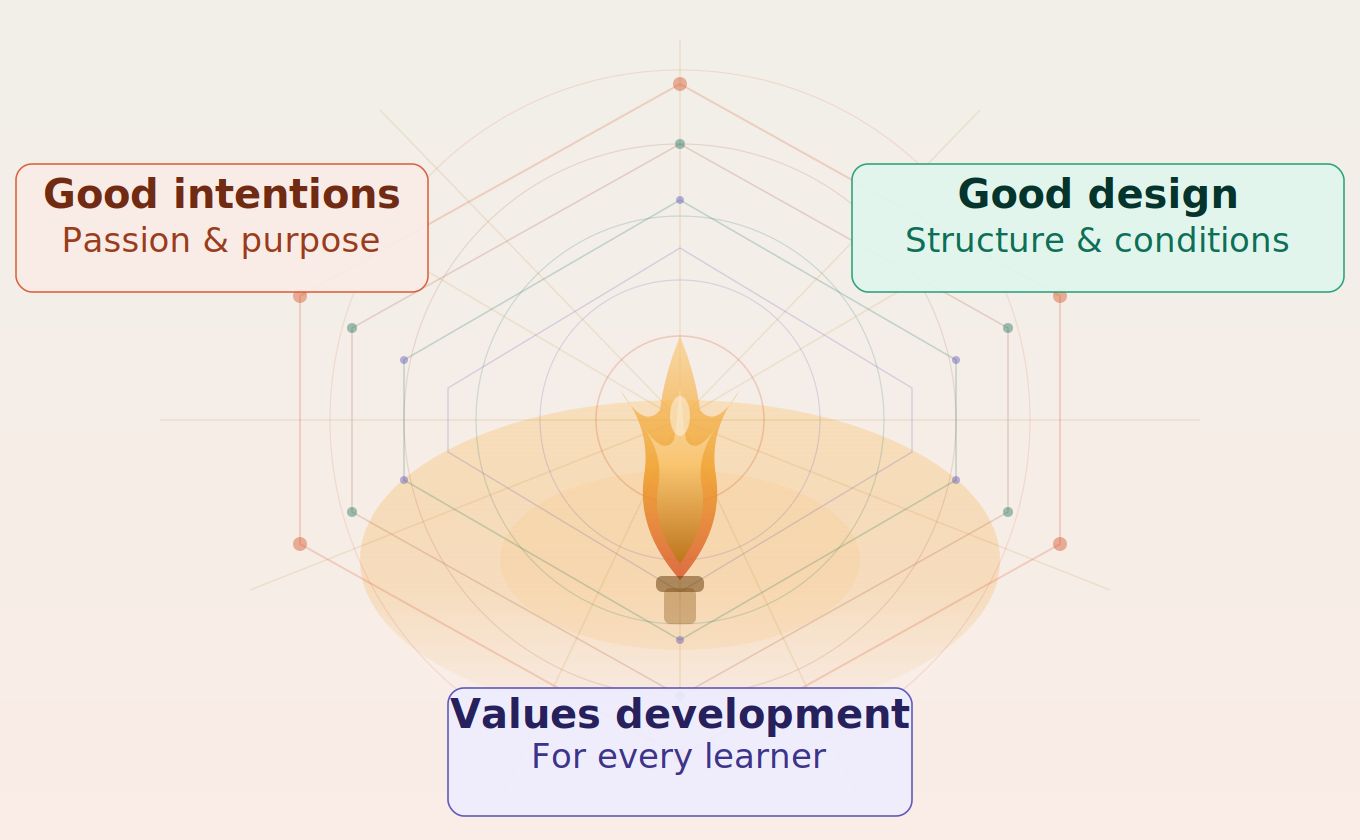
That question is harder than it sounds. Good intentions, warm relationships, and a genuine commitment to learner growth are necessary but not sufficient, especially when multiple cultures are in play. Research consistently shows that poorly designed VbE programs can produce outcomes directly opposite to those intended — not indifference, but active resistance. Understanding why this happens, and what to do instead, is the practical heart of the VbE literature.
The Backlash Effect: When Good Intentions Backfire
Research Spotlight: Did you know that mandatory diversity and values training can actually make things worse? Dobbin and Kalev (2016) analyzed 30 years of data from over 800 organizations and found that coercive training programs frequently decreased rather than increased inclusion — while voluntary, relationship-centered approaches produced meaningful gains.
Research on multicultural and diversity education has long documented what is sometimes called the “backlash effect”: mandatory programs designed to shift attitudes can, under certain conditions, calcify rather than open them. Tabit et al. (2016) provide a detailed theoretical account of this phenomenon within the BEVI framework, identifying the mechanism as identity threat. When learners perceive that a program is asking them to abandon their existing values rather than examine them, self-protective resistance is a predictable and rational response.
Our own research confirms this dynamic in educational contexts. Iseminger et al. (2020) found that students who experienced VbE curricula as coercive — as exercises in values correction rather than values exploration — showed significantly lower growth on intercultural and reflective dimensions than their peers in programs designed around genuine inquiry. The implication is not that educators should avoid challenging learners’ assumptions. It is the design of that challenge determines whether it opens minds or closes them.
This is a sobering finding for a field that attracts practitioners with deep moral commitments. Passion for the work is not enough, and can even become a liability when it leads educators to prioritize transmission of particular values over the cultivation of learners’ own reflective capacities.
A Case Study in What Can Go Right
Consider Maya (pseudonym), a U.S. undergraduate who spent a semester studying in Chile. By conventional metrics — language immersion, cross-cultural friendships, academic engagement — her program was a success. But Dr. Jennifer Wiley, a researcher and practitioner whose work has shaped how we think about transformative learning assessment, describes what a more intentional VbE approach made possible.
Midway through her semester, Maya participated in a structured BEVI debrief, a facilitated process in which her own psychometric profile was returned to her as an object of reflection rather than evaluation. The data showed significant movement on scales related to sociocultural openness and self-certainty. But the debrief itself was the intervention: a skilled facilitator helped Maya connect those shifts to specific experiences, to articulate what had changed in her framework for understanding difference, and to name the discomfort that preceded growth.
As Wiley and colleagues (2021) have reflected, what distinguished this experience was not the discomfort itself — study abroad routinely generates discomfort — but the structured opportunity to make meaning of it. Assessment, in this model, is pedagogy. The instrument does not merely measure transformation; in the hands of a skilled facilitator, it catalyzes it.
Maya’s story illustrates what the research literature increasingly affirms: the conditions surrounding a values-laden experience matter as much as the experience itself. Which raises the question: what are those conditions, systematically?
Research Spotlight: Did you know that program participation alone is not enough to produce intercultural growth? Krishnan and colleagues (2017) found that short-term service-learning study abroad students showed only mixed IDI gains when left to their own experience — but demonstrated significant intercultural competence development when intentional, culturally focused learning activities were embedded in the curriculum, underscoring that design, not exposure, is the active ingredient.
Frameworks for Getting It Right
The 7 D’s: Design Principles for Transformative Experiences
Wandschneider et al. (2015) offer one of the most practically useful frameworks in the VbE literature: seven design principles, each beginning with the letter D, that predict whether an educational experience is likely to produce genuine values development. Like all good alliterative frameworks, it is more transparent in practice than in name, so each principle bears a brief explanation.
Duration refers to the length and sustained intensity of the experience. Brief exposures — a single workshop, a one-day service event — rarely produce the kind of deep reexamination that values change requires. Meaningful VbE creates conditions for extended engagement with challenging material.
Difference is the degree of genuine contrast with learners’ existing frameworks. The experience must present perspectives, people, or situations genuinely unfamiliar enough to destabilize comfortable assumptions — without being so foreign that learners cannot find any foothold for engagement.
Depth concerns how deeply the experience engages the underlying structures of self — beliefs, formative experiences, emotional responses — rather than surface behaviors or factual knowledge. Programs that stay at the level of information rarely move the needle on values.
Determine is the assessment imperative: know what actually changed and for whom. As the second post in this series argued at length, without rigorous attention to outcomes — who changed, in what direction, by how much — we cannot distinguish effective programs from ineffective ones, or identify which learners need additional support.
Design refers to the intentional architecture of the program as a whole. The backlash effect is, in most cases, a design failure: programs that did not build in genuine choice, scaffolded challenge, or explicit attention to learner readiness. Good design does not eliminate discomfort; it makes discomfort productive.
Delivery is how the experience is facilitated in practice. A well-designed program can still fail in the hands of a facilitator who is unprepared, who lacks the cultural competence the content demands, or who has not done the reflective work of examining their own values — a point we return to below.
Debriefing is, for many practitioners, the most consistently underestimated principle. Structured, skillful reflection that helps learners integrate and make meaning of what they have experienced is not a supplementary add-on; it is often the primary site of transformation. Maya’s story is, in essence, a story about what exceptional debriefing makes possible.
In K–12 Settings: The PRIMED Model
For educators working in schools, Berkowitz’s (2021) PRIMED model offers a parallel framework grounded in over four decades of character education research. Recognized with the 2023 AERA Outstanding Book Award, PRIMED for Character Education synthesizes the evidence base into six design principles for school improvement.
Prioritization means character is not one initiative among many but a genuine organizational commitment — reflected in resource allocation, scheduling, and leadership attention. Relationships recognizes that values development occurs in relational contexts; the quality of teacher-student and peer relationships is not incidental to the work but central to it. Intrinsic motivation and Internalization together capture the core insight shared across the VbE literature: external compliance is not values development. The goal is not behavior management but the cultivation of internalized ethical commitments.
Modeling foregrounds the educator’s own character as the most powerful curriculum in any school. What teachers and administrators do — how they treat students, handle conflict, respond to failure — is read far more carefully than what they say. Empowerment insists that students must be active agents in their own development, with genuine voice and meaningful opportunities to practice ethical reasoning. Finally, Developmental pedagogy demands that VbE meet learners where they are — calibrated to their developmental stage, attentive to readiness, and sequenced for growth over time.
Across All Settings: The MIRACLES Framework
A third framework, developed specifically for values-based education for sustainable development (VbESD), offers a bridge between school-focused and broader educational contexts. Huang, Pagano, and Marengo (2024) synthesized the VbESD literature into eight evidence-informed pillars validated across 157 educational practitioners and researchers.
The framework’s pillars — Modeling, Inner Curriculum, Reflection, Atmosphere and ethos, Curriculum, Leadership, Ethical vocabulary, and Sustainable school operations — are notable for what they include that purely individual-focused frameworks omit: the institutional and environmental conditions that shape whether values development is even possible. An organization that preaches sustainability while its operations embody waste, or that speaks of ethical community while its power structures are opaque, is sending a curriculum more powerful than anything in its syllabi.
The MIRACLES framework also foregrounds the role of ethical vocabulary — the shared language through which a community names and reasons about its values. This is not merely semantic: communities that lack a common vocabulary for ethical reflection cannot engage in it together, and programs that assume such a vocabulary exists where it does not will consistently fall short of their aims.
From Principles to Practice
Taken together, these frameworks converge on several practical imperatives that cut across educational levels and contexts. First, educator self-awareness is not optional. Research by Shealy and Brewster (2022) and others in the EI tradition demonstrates that facilitators who have not examined their own formative experiences, belief structures, and values blind spots are poorly positioned to guide others through that process — and may, without intending to, reproduce the very dynamics that generate backlash. Investment in educator development is therefore a prerequisite for effective VbE, not an add-on.
Second, institutional conditions shape individual outcomes. The PRIMED and MIRACLES frameworks both insist that values development cannot be fully delegated to individual educators or isolated programs: it requires the alignment of organizational culture, leadership behavior, resource allocation, and structural design. A transformative learning experience embedded in an institution that does not model the values it espouses is fighting uphill.
Third, assessment must be built in from the beginning, not appended at the end. The “Determine” principle in Wandschneider et al. (2015) and the rigorous outcomes research examined in Post 2 of this series both point to the same conclusion: without systematic attention to what is changing for whom, programs cannot improve, funders cannot evaluate, and learners cannot make meaning of their own development.
Finally, and perhaps most fundamentally, the ultimate goal of VbE is not the transmission of particular values but the cultivation of the reflective capacity to examine, articulate, and act on one’s own values. Programs that conflate these goals — that treat values education as values correction — not only risk backlash; they undermine the very autonomy and critical thinking that a values-educated person requires.
Conclusion
This series has moved from theory to evidence to practice — from the question of what values-based education is, to how we know whether it is working, to how we design and deliver it well. What emerges across all three posts is not a simple prescription but a coherent set of commitments: to theoretical clarity, to rigorous and humane assessment, and to program design that takes learner complexity seriously.
Values-based education, at its best, is not an intervention done to learners. It is a set of conditions created with them — conditions that make the difficult, disorienting, and ultimately generative work of values development possible. The frameworks reviewed here do not make that work easy. But they make it more likely to succeed, and less likely to cause harm. In a field animated by deep moral purpose, that is exactly the kind of rigor the work deserves.
Contribute to the Conversation
This introductory series on the three blog themes represents some common perspectives on Values-Based Education, but the conversation is far larger than any three posts can capture. The GAVE Research Committee invites GAVE members and anyone engaged with VbE scholarship or practice to contribute a blog post to the GAVE website. Posts should be 500–1000 words, written for a lay audience, and include a brief positionality statement, at least one image or other multimedia element, and citations as appropriate.
Looking for a starting point? Consider pointing readers to a foundational VbE publication, celebrating a recent piece of scholarship, describing a current project, recommending a specific approach or strategy, highlighting an inspiring case study, or identifying a direction for inquiry that the field has not yet fully explored. The three themes organizing this series — conceptualizations and frameworks, research methods, and best practices — are invitations to further dialogue, not a closed syllabus.
To indicate interest, please complete a brief survey or reach out directly to the GAVE Research Committee chair with questions. We look forward to hearing from you.
References
Acheson-Clair, K., & Dirkx, J. (2021). Transformative learning as values-based education: A theoretical framework for intercultural competence development. Journal of Transformative Education, 19(4), 295–305. https://doi.org/10.1177/15413446211045158
Berkowitz, M. W. (2021). PRIMED for character education: Six design principles for school improvement. Routledge.
Dobbin, F., & Kalev, A. (2016). Why diversity programs fail. Harvard Business Review, 94(7), 52–60. https://ofew.berkeley.edu/sites/default/files/why_diversity_programs_fail_dobbin_kalev.pdf
Huang, R. X., Pagano, A., & Marengo, A. (2024). Values-based education for sustainable development: A framework synthesis. Sustainability, 16(9), 3562. https://doi.org/10.3390/su16093562
Iseminger, S., Acheson-Clair, K., Kelly, C., & Morris, P. (2020). Backlash and breakthrough: Student responses to values-centered curricula. International Journal for the Scholarship of Teaching and Learning, 14(1), Article 12. https://doi.org/10.20429/ijsotl.2020.140112
Krishnan, L. A., Masters, C., Holgate, H., Wang, C., & Calahan, C. A. (2017). Structured study abroad enhances intercultural competence. Teaching and Learning in Communication Sciences & Disorders, 1(1), Article 5. https://ir.library.illinoisstate.edu/tlcsd/vol1/iss1/5/
Shealy, C. N. (2016). Making sense of beliefs and values: Theory, research, and practice. Springer.
Shealy, C. N., & Brewster, L. (2022, October). Educator self-awareness and the EI framework: Implications for values-based facilitation [Symposium]. International Transformative Learning Conference.
Tabit, M. B., Legault, L., Ma, W., & Wan, K. P. (2016). In search of best practices for multicultural education: Moving from the margins to the mainstream. In C. N. Shealy (Ed.), Making sense of beliefs and values: Theory, research, and practice (pp. 261–302). Springer.
Wandschneider, E., Pysarchik, D. T., Sternberger, L. G., Ma, W., Acheson-Clair, K., Baltensperger, B., Good, R. T., Brubaker, B., Baldwin, T., Notto, J., Matysik, F.-M., Friedow, B., & Shealy, C. N. (2015). The Forum BEVI Project: Applications and implications for international, multicultural, and transformative learning. Frontiers: The Interdisciplinary Journal of Study Abroad, 25, 150–228.https://doi.org/10.36366/frontiers.v25i1.350