
Contributing authors: Shagufa Kapadia and Rachana Bhangaokar
Tasks: Celebrate a recent or upcoming publication
Keywords: human development, values, lifespan, culture, India, decolonize
Positionality Statement: As scholars of human development from the Global South, we are actively engaged with the ongoing discourse on decolonizing human development (or developmental science) to move beyond “received” worldviews, and include culturally and contextually relevant frameworks and approaches. Turning inward has been a rewarding experience in that it has urged us to discover culturally rooted ideas, concepts and frameworks that have immense potential for enhanced understanding of human development as human thriving in an ambience of coexistence and collective wellbeing. Through teaching, research and real-world applications, our commitment is to expand mainstream developmental discourse by foregrounding indigenous perspectives, interdependence, ethics, community, and lived experience. We seek to create a dialogue between diverse knowledge traditions to reimagine human development as humane, culturally responsive, and socially meaningful.
Introduction
What issues plague the world today? Incessant violence. Economic and social uncertainty. A sinking planet with diminishing resources. At the root of this is the process of ‘othering’ that emphasizes irreconcilable differences among human groups, human beings and nature, and human greed for a materially well-endowed future.
From an Indian philosophical perspective, all causes of this crisis are nothing short of an illusion about the nature of human consciousness. Such illusions are essentially born out of avidya or ignorance about the nature of reality.
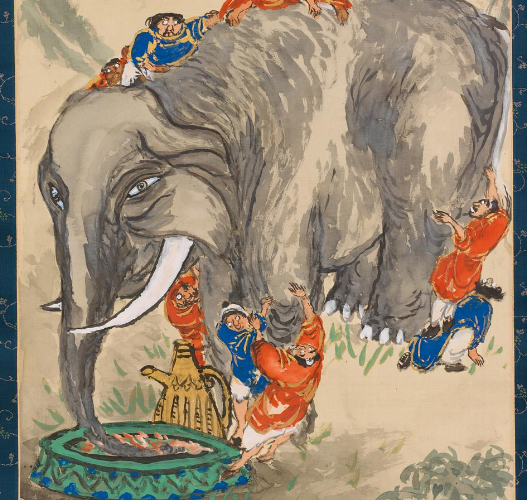
The above picture is an illustration for understanding complex situations. Drawing from an ancient Buddhist parable, the picture depicts some blind men trying to comprehend the object of inquiry with limited sensory access. Given their sensory and experiential limitations, the blind men attribute analogous form and meaning to different parts of the elephant, like a snake for the trunk or rope for the tail, that seem familiar. They erroneously consider one part that they have access to, as the whole object. When others with a more complete sensory and experiential advantage engage in such inquiry, chances are that the analogies may disappear and reality may appear “as is” – the whole elephant and nothing else.
Our understanding of the world today is entangled in a similar disadvantage. Global Psychology and its many sub-disciplinary divisions are ontologically restricted by invisible boundaries, compelling scholars to operate within watertight silos. Can discussing issues from a variety of vantage points or transcending disciplinary boundaries give us a fuller, more inclusive and accessible view of human nature? The interdisciplinary field of human development offers a space to begin such an inquiry.
Reimagining Human Development through Values
The recently published ‘A Handbook of Human Development: Perspectives from India’, offers a rethinking of development through Indian cultural and philosophical lenses. Rather than viewing development merely as individual advancement, the handbook situates human growth within relationships, ethical responsibility, culture, spirituality, community, and wellbeing across the lifespan.
The volume highlights that development is culturally rooted, relational, contextual, and moral. Indian philosophical traditions have traditionally held that the person is intertwined with family, society, nature, and the greater cosmos rather than being in isolation. As a result, rather than being optional moral add-ons, values like empathy, obligation, harmony, self-control, respect for diversity, and social responsibility become fundamental developmental capacities. The handbook encourages us to pose in-depth queries:
- What kind of individuals are we developing into?
- How do we interact with other people?
- What role do people play in the well-being of the group?
- Is it possible for development to take place without empathy, moral consciousness, or purpose?
Notably, the Handbook is an attempt to create space for decolonized developmental psychological knowledge from the Global South. With the help of models embedded in Indian cultural realities, it bridges ancient Indian wisdom and contemporary research about human development in India, covering major life stages and cultural variations therein. This not only ‘creates space’ for understanding ways of being in different parts of the world, but also encourages readers to engage with divergent worldviews, other than those from Europe and North America that dominate existing academic discourses. Each chapter offers evidence-based insights into how at different life stages, Indians traverse the myriad pathways of continuity and social change in a post-colonial, neoliberal society.
Select chapters capture the resonance of Gandhian values of non-violence and truth with the challenges posed by increasing individualism, violence and discrimination. Underscoring the importance of foundational years in childhood for holistic, inclusive and healthy human development, the chapters present evidence-based research and policy provisions across different life stages of adolescence, emerging and established adulthood, and aging in India. Mapping the centrality of the family amidst shifting cultural values and family forms, the handbook examines gender and pedagogy of training in higher education in the field from multiple perspectives.
Research Spotlight: If you’d like to learn more about the chapters included in the Handbook, see the Table of Contents for the volume on Springer’s site here.
Contributions to Global Discourse
While rooted in Indian perspectives, the insights presented in the handbook resonate far beyond India and hold considerable global relevance. Across the world, researchers and practitioners are increasingly questioning developmental models that focus primarily on the individual in isolation. Contemporary global challenges call for approaches to human development that emphasize ethics, relationships, community, and collective wellbeing. Indian perspectives make a distinctive contribution to these global discussions by highlighting:
- development as a process of interconnectedness,
- the self as fundamentally relational,
- wellbeing as shared and collective,
- morality as something embodied in everyday practice,
- and human growth as a journey of ethical becoming.
These ideas are reflected in everyday social practices across India. The Sikh institution of langar, in which individuals from all walks of life prepare and share meals together, reflects the principles of equality, service, and collective responsibility (Singh, 2001). Likewise, women’s Self-Help Groups illustrate how shared participation in financial, social, and community activities fosters not only economic empowerment but also confidence, social capital, and collective agency (Brody et al., 2017). Such practices reveal a conception of human development as inherently relational and ethical in nature, wherein individual growth is fostered through communal participation and a sustained commitment to the collective good.
Yet another example is the Sacred Groves Project. Sacred Groves are patches of natural forest that have been protected for generations by local communities because of their religious, cultural, or spiritual significance. Found across many parts of India, these groves represent a traditional form of community-led conservation in which activities such as tree felling, hunting, and resource extraction are restricted. As a result, they serve as important reservoirs of biodiversity, protect water sources, prevent soil erosion, and support local ecosystems. More than an environmental practice, sacred groves reflect an Indian worldview that recognizes the interdependence of humans and nature, where caring for the environment is viewed as a moral and collective responsibility. They offer a powerful example for students of how cultural values and community traditions can contribute to ecological sustainability and the well-being of both present and future generations (Malhotra et al., 2007).
Conclusion
The volume encourages readers to reflect on values that make us human and connect us to families and communities in varied contexts, making it a globally relevant publication. It reminds us that values remain at the heart of meaningful development. Empathy, responsibility, dignity, compassion, moral reflection, and social connectedness are not secondary virtues – they are foundational capacities for human flourishing.
The handbook promises to fuel academic discussions across geographical and disciplinary boundaries about salient existential issues affecting human wellbeing and the future of humanity. Development, ultimately, is not only about “becoming” successful. It is about “being” humane – through inner exploration, which is essential for understanding the “other” – in turn laying the foundation of “doing” – our actions, relationships, and contributions toward the growth and development of others (Kapadia, 2021).
References
Brody, C., De Hoop, T., Vojtkova, M., Warnock, R., Dunbar, M., Murthy, P., & Dworkin, S. L. (2017). Economic self-help group programs for improving women’s empowerment: A systematic review. Campbell Systematic Reviews, 13(1), 1–182. https://doi.org/10.4073/csr.2017.19
Kapadia, S., & Bhangaokar, R. (Eds.). (2026). A handbook of human development: Perspectives from India. Springer. https://doi.org/10.1007/978-981-95-4037-2
Kapadia, S. (2021, February 15 -16). Human development in everyday life [Keynote address]. International Virtual Conference on Interdisciplinary Scope of Human Development, Department of Human Development, Mount Carmel College, Bengaluru, India.
Malhotra, K. C., Gokhale, Y., Chatterjee, S., & Srivastava, S. (2007). Sacred groves in India: An overview. Aryan Books International.
Singh, P. (2001). The Sikhs. Image Books
Smithsonian’s National Museum of Asian Art. (n.d.). Blind men appraising an elephant [Artwork]. https://asia-archive.si.edu/object/F2019.3.34a-f/